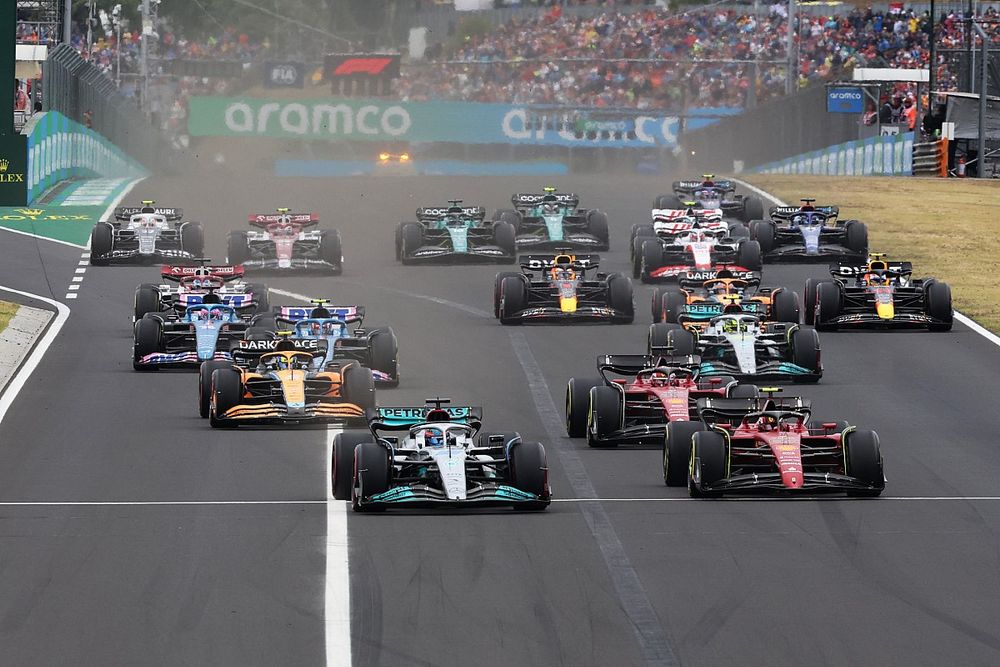
Charles Leclerc’s shock Formula 1 pole position for the Hungarian Grand Prix has set up an intriguing battle at the Hungaroring as he aims to fend off the McLaren duo of Oscar Piastri and Lando Norris.
While the McLarens can be expected to be quicker over a race stint as rear tyre wear comes into play, Leclerc was actually in the same ballpark during Friday’s FP2 long runs, splitting long-run leader Piastri and Norris.
Hungary is a track-position race due to its lack of overtaking opportunities, but a variety of available strategy options and the threat of rain could add some intrigue to the 70-lap contest.
Speaking in favour of Leclerc is starting on the clean side of the grid, on new asphalt, while second-placed Piastri is starting from the lower-grip inside. At the start of Saturday’s F2 sprint race, second-placed McLaren junior Alex Dunne immediately fell into the clutches of third-place starter Arvid Lindblad, and if that is anything to go by then Piastri might become more concerned about keeping title rival Norris behind than having a go at Leclerc.
If Leclerc does hold the lead, passing the higher-top-speed Ferrari on track will be a challenge and a half, even for the McLarens. But Pirellis is predicting a variety of viable pitstop strategies that can help the Monegasque’s nearest chasers.
The quickest strategy in theory is a two-stopper on medium-hard-hard, closely followed by a one-stop on medium-hard. Even the soft tyre could come into play in Sunday’s cooler conditions for drivers wanting to be aggressive at the start before trying to undercut their rivals.
However, unlike Leclerc neither McLaren drivers has a second set of hew hards, which will force them to take a used set or pick a different strategy.
“For them there is the possibility to start with a one-stop strategy with the idea of a one-stop medium/hard,” said Pirelli chief Mario Isola.
“At the moment a one-stop is more or less 10 seconds slower with the level of degradation that we measured on Friday. If it is cooler and you are able to manage better the tyre, it could be less. That’s why I believe that two-stop is still the preferred choice.”
