
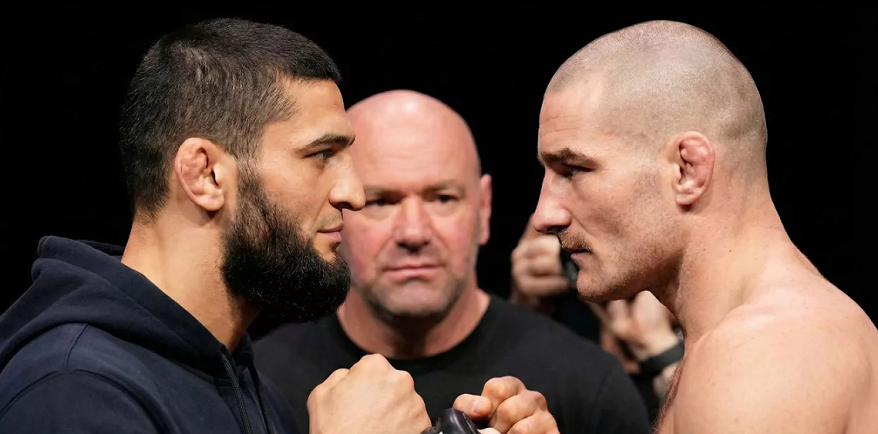
The Octagon lands in Newark for UFC 328, which has a case as the Ultimate Fighting Championship’s best card of 2026 thus far on paper. At the very least, it has the best one-two punch in terms of headliners. Middleweight champion Khamzat Chimaev might not have any obvious tests on the horizon, but challenger Sean Strickland has a case as the toughest potential fight of the bunch, on top of bringing some promotional heat to the affair.
Meanwhile, the future is now in the co-main event, as flyweight champion Joshua Van and challenger Tatsuro Taira square off in the UFC’s first title fight between two fighters born in the 21st century.
Past that, there are some massive stakes; Alexander Volkov or Waldo Cortes-Acosta could put themselves in position for a heavyweight title fight with a win, while Sean Brady and Joaquin Buckley each need a big win — and to avoid a loss — in order to stay in the welterweight title picture. Add in a fun battle between lightweight veterans King Green and Jeremy Stephens to open things up, and this main card has a little bit of everything.
The Chimaev era of the middleweight division is here, but how long will it last? Chimaev was the UFC’s most talked-about newcomer in 2020, as the Russian kicked off his career in a manner that was hard to ignore. He ran over John Phillips at middleweight in his UFC debut, turned around 10 days later to run through Rhys McKee at welterweight, then scored a first round knockout of Gerald Meerschaert at middleweight less than two months after that.
It seemed destined that Chimaev would work his way into contender status — sooner rather than later given his rate of activity — and the UFC saw fit to fast-track him into the welterweight title picture, matching him with top contender Leon Edwards just a few months out from the Meerschaert win.
Then it looked like Chimaev might wind up as one of the greatest what-ifs in mixed martial arts history; the Edwards fight was repeatedly scrapped due to Chimaev dealing with a severe case of Covid-19 that at one point had “Borz” announcing his retirement, only to quickly walk that decision back.
The end result was a yearlong layoff before Chimaev essentially picked up where he left off. He ran through Li Jingliang in short order before surviving the first real test of his career against Gilbert Burns, who steeled himself enough to engage Chimaev in a three-round war that answered some questions about the Russian’s toughness but raised some concerns about his gas tank.
Surprisingly, Chimaev’s next booking was a main event against Nate Diaz that seemed quite unnecessary and an easy Chimaev win on paper, only for him to nearly jeopardize the entire card by missing weight by nearly 10 pounds, necessitating a ton of shuffling to save the event and resulting in Chimaev’s full-time move up to middleweight. Chimaev’s only fought once per calendar year since this last move up to middleweight, with the toughest fight actually being the first of the bunch against Kamaru Usman. The former welterweight champ took the fight up a division on late notice and had a similar performance to Burns, dragging Chimaev into an even fight after a big Chimaev first round.
Chimaev would then run through Robert Whittaker to establish himself as middleweight’s top contender, and champion Dricus Du Plessis figured to be an interesting challenge; his commitment to chaos figured to give Chimaev a ton of openings, but provided the South African could survive early, the thought was that he could test Chimaev’s gas tank to a level beyond anything the challenger had previously experienced.
Instead, it was a fairly clean Chimaev five-round win, as either due to a lack of skill or poor game planning, du Plessis essentially did nothing as the fight repeatedly went to the ground, which in turn allowed Chimaev to repeat his dominant first round without draining much of his cardio. Now Chimaev’s first title defense comes against Strickland, who looks to succeed where du Plessis couldn’t and score his second massive upset of a middleweight champion.
Strickland had his own breakout 2020, even if it wasn’t tremendously obvious at the time. By that point, Strickland was already a well-regarded veteran who came to the UFC young and put in a few years of solid work as a technically sound but generally unnotable welterweight — until a massive motorcycle crash in 2018 that seemed like it would end his career.
Things wound up with Strickland out of action for roughly two years, but he was a new man in a few different ways upon his return; he was now a full-time middleweight, and had apparently spent the time honing what would become his signature style, an upright pressure striking approach that looks to march down his opponents and take them apart with volume.
It proved shockingly successful at first, with Strickland winning five straight fights in one-sided fashion even as he started getting main event opportunities, but it seemed like he finally hit his ceiling near the end of 2022; his commitment to striking and reliance on his defensive vision wound up with walking right into a knockout blow from Alex Pereira, and a much more even fight tactically saw him lose a decision to a much harder hitter in Jared Cannonier.
Strickland entered 2023 as the middleweight gatekeeper to the elite, and had the UFC planned their schedule better that might still be the case. The promotion had a September card in Australia where Israel Adesanya was slated to defend his middleweight title, and while du Plessis was the obvious next contender, he was booked for a fight against Whittaker just two months prior, leaving him unavailable to fight Adesanya due to his injuries.
Strickland happened to be the best opponent available that was also a fresh challenge for Adesanya, and so Strickland shockingly got the title shot in what was expected to be a walkover Adesanya win – instead, Strickland clipped the champion early and never let him back into the fight, becoming one of the unlikeliest champions in UFC history.
